Wait, Who's Delia? The Forgotten Omen IV Character Who Almost Replaced Damien
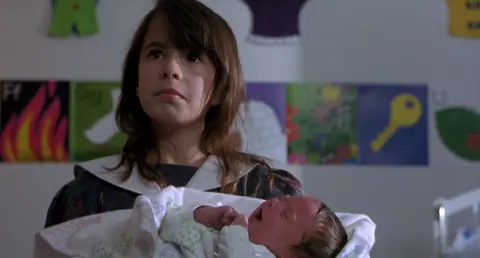
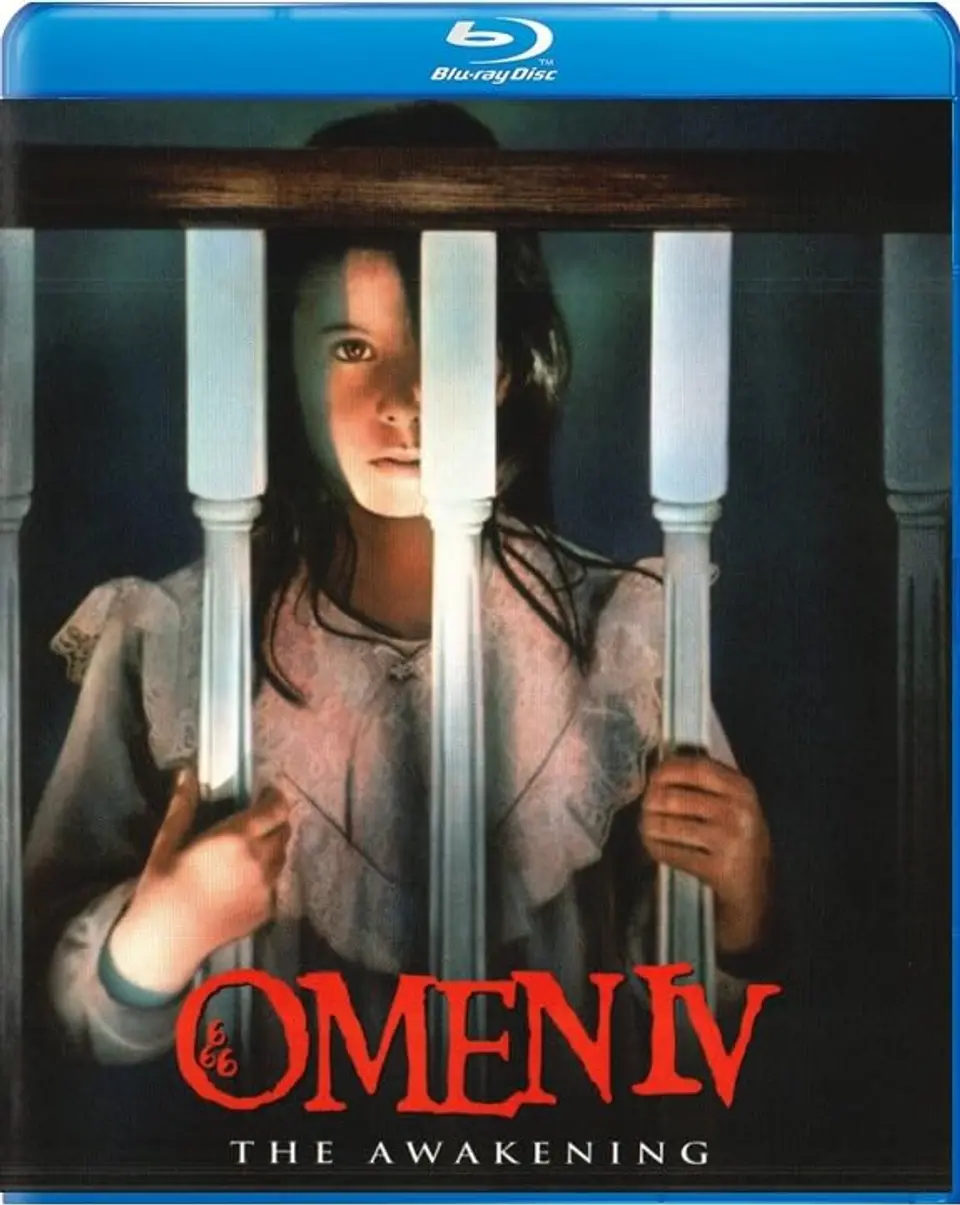
 I've always had a complicated relationship with Omen IV: The Awakening. If you've read my Ultimate Guide to The Omen franchise, you already know where I land on the 1991 made-for-TV sequel: I don't hate it, I respect what it was trying to do, and compared with the original trilogy it is still pretty much the definition of “meh.” That is not exactly the kind of endorsement you put on the Blu-ray box. But there is one thing about Omen IV that has stuck with me way more than the movie itself and that is Delia York.
The Omen scared the crap out of me when I was a kid, courtesy of my Aunt Kim, and Damien Thorn has been wired into my horror brain ever since. So when a franchise built almost entirely around Damien. killed him off in Omen III: The Final Conflict and then came back ten years later, the obvious question was not just: how do you make another Omen movie? It was how do you make an Omen movie without Damien?
For most of Omen IV, the answer is Delia. A little girl. Damien's daughter, in fact. A child who seems to understand far more about the darkness around her than young Damien ever did. And for about 90 minutes, the movie quietly flirts with an idea that could have completely changed the franchise, and then it backs away from it.
That is what makes Delia so fascinating to me now. She is not simply a forgotten character from the weird TV sequel everyone skips during an Omen marathon. She is the character who nearly proved this franchise did not need Damien Thorn at the center of it at all.
Yes, this entire article is a giant spoiler for a 35-year-old television movie.
If Omen IV: The Awakening has somehow been sitting untouched on
your watchlist since 1991, this is your warning!
Who Is Delia in Omen IV: The Awakening?
Delia York, played by Asia Vieira, is introduced as the adopted daughter of Gene and Karen York, played by Michael Woods and Faye Grant. The setup is deliberately familiar because Omen IV knows exactly which franchise it belongs to. A successful couple brings home a child whose origins they do not fully understand, unsettling things begin happening around the family, and before long one parent is looking at this kid like maybe the adoption paperwork should have included a section on biblical prophecy.
The parallels to the original The Omen are obvious, but Delia is not simply Damien with pigtails. That is where the movie starts getting interesting.
Young Damien was terrifying partly because so much of the horror came from the adults around him. In the original movie, he does not spend two hours explaining his evil master plan or twirling a tiny mustache. He is a child while the world around him becomes increasingly impossible. Delia feels different from the beginning. She is aggressive, perceptive and much more knowingly unsettling, and Asia Vieira gives her a confidence that suggests she understands the effect she has on people even when the adults are still trying to explain everything away.
Karen eventually begins investigating Delia's background, first through the family's nanny, Jo, and then through private investigator Earl Knight. The deeper that investigation goes, the closer the story gets to the name we have been waiting for.
Delia is Damien Thorn's daughter.
That should be an enormous franchise revelation, and I still think Omen IV does not get enough credit for it. The Final Conflict had actually ended Damien's story. Rather than resurrecting him, pretending his death did not count or finding some increasingly ridiculous supernatural loophole, Omen IV says his bloodline continued. Evil does not need Damien himself anymore. It can move forward through the next generation.
For Most of Omen IV, Delia Is the Franchise
This is the part of Omen IV I genuinely like, because the movie spends most of its runtime positioning Delia as the new center of The Omen mythology without simply announcing, “Congratulations, everyone, here is Female Damien.”
She occupies the same basic narrative space Damien once did, but the energy is different. Strange deaths follow her. Animals react to her. Adults who get too curious tend to discover that curiosity has a truly terrible benefits package - just like in The Conjuring Universe. Yet Delia herself feels less passive than Damien did at the same age. There is something much more deliberate about her presence.
The movie also plays directly with the possibility that Delia could be the Antichrist. After three films centered on a male figure, Omen IV raises the question of whether everyone has been reading the prophecy through assumptions rather than certainty. In 1991, that could have been a pretty major reinvention of a franchise that had already taken Damien from creepy child to teenager to adult businessman with apocalyptic ambitions.
And I think that is why Delia works better than the movie around her. Omen IV is often recycling pieces of The Omen, sometimes so openly that you can practically hear the screenplay checking boxes, but Delia is the one element that points somewhere new. She could have carried the mythology forward while changing the perspective completely.
There is also something more unnerving about a child who appears to have some awareness of what she is. Damien's gradual realization in Damien: Omen II gives that movie much of its identity. Delia feels as though she has entered the story several steps ahead of everybody else. Karen is trying to figure out what is happening inside her own house while Delia often looks like she is waiting for the adults to catch up. That is a sequel engine. A pretty good one, actually.

The Delia Twist Changes Everything
And then Omen IV gets very, very Omen IV. Late in the movie, Karen confronts Dr. Hastings and discovers that Delia is indeed Damien's daughter, but she is not the new Antichrist. Delia had a twin brother whose embryo remained inside her. Hastings removed that embryo and implanted it into Karen, which means Karen's miraculous pregnancy has actually made her the surrogate mother of Delia's biological twin.
That baby is Alexander, and Alexander bears the 666 mark. I will give the movie this: nobody can accuse that reveal of being boring. It is an absolutely wild mythology swing involving Damien's daughter, a retained twin embryo, a secret implantation and the arrival of another male Antichrist. This franchise has never been shy about satanic conspiracies requiring an astonishing number of people to stay committed to the plan, but this is next-level logistics.
The problem is that the movie has spent almost all of its time making Delia interesting, only to reveal that the “real” successor is a baby we have barely gotten to know. Delia has personality. She has menace. She has agency. We have watched her manipulate people, terrify Karen and carry the movie's supernatural tension. Alexander has a birthmark and, being fair to him, is an infant.
So the movie effectively spends 90 minutes introducing the next major Omen character and then tells us the franchise centerpiece is actually her brother. That has always felt like such a strange creative retreat to me. Omen IV gets right to the edge of doing something genuinely bold with the mythology, then pulls back toward the safer idea that the Antichrist still needs to be Damien 2.0, complete with the familiar 666 branding.
Why Delia Still Bugs Me
This is where my “Omen IV is meh” opinion gets complicated, because I think Delia is more interesting than that rating suggests. I do not suddenly think Omen IV is some misunderstood masterpiece. It is still a made-for-TV sequel that recycles a lot of the original film's architecture, lacks the suffocating religious dread of the first movie and never finds the cinematic weight of the original trilogy. Jerry Goldsmith's absence alone changes the entire temperature of the thing. The movie knows many of the ingredients that make an Omen story, but knowing the ingredients and cooking the meal are two very different things.
Still, I respect the attempt to move beyond Damien, and Delia is the reason why. The movie accidentally demonstrates that The Omen can survive without him before losing confidence in that very idea.
Imagine Delia growing up knowing exactly who her father was. Imagine a sequel following Damien Thorn's daughter as she becomes an adult while the satanic network around her expects her to protect Alexander, guide him or perhaps eventually challenge him. Imagine the family dynamic of two children carrying Damien's bloodline in completely different ways, one marked as the Antichrist and the other already demonstrably supernatural in her own right.
That is not just Damien's story with the pronouns changed. It is a different way into the mythology, and it raises questions the original trilogy never had any reason to ask.
Instead, Alexander gets the 666, Delia gets the much more interesting character, and the franchise never follows either of them again. Horror franchises have abandoned a lot of dangling sequel hooks over the years, but leaving the literal granddaughter of Satan standing there with no follow-up is an especially impressive bit of unfinished business.
What Happened to Delia After Omen IV?
On screen, absolutely nothing. Omen IV ends with Karen dead and Gene leaving her funeral with Delia and baby Alexander. He does not understand the full truth about what has happened, both children are alive, and the satanic conspiracy has essentially won. It is the kind of ending that feels designed to keep going. It never did.
Producer Harvey Bernhard returned for Omen IV and developed the story with Brian Taggert, but the movie did not lead to another screen sequel continuing Delia and Alexander's story. When The Omen returned to theaters in 2006, it started over with a remake of the original. The 2016 Damien television series created another continuity altogether, following an adult Damien directly from the 1976 film and ignoring the original theatrical sequels.
That leaves Delia in one of the strangest positions in the franchise. She is not a throwaway side character or somebody from an obscure tie-in novel. Within the original sequel timeline, she is Damien Thorn's daughter, Alexander's twin and a supernatural figure who survives the movie with the forces of evil firmly in control. Then the entire branch of continuity simply ends.
The Omen Eventually Learned the Lesson Omen IV Almost Did
One of the reasons Delia feels more interesting to me now is The First Omen. When I spoke with Nell Tiger Free around that film's release, I was already fascinated by the way The First Omen found a new route into mythology I had known since I was a kid. The movie does not need Damien running around at the center of every scene to feel unmistakably like The Omen. It focuses on Margaret, on religious institutions, bodily autonomy, control and the machinery required to create the evil we already know is coming.

The First Omen is obviously a very different movie from Omen IV, and Margaret and Delia are very different characters. But The First Omen proves something Omen IV was circling decades earlier: this mythology can expand when it stops treating Damien as the only interesting thing in the room.
That makes Delia look less like a failed Damien replacement and more like an early glimpse of a franchise possibility nobody followed through on. Maybe that is why I keep coming back to her even though I am never going to pretend Omen IV suddenly belongs beside the 1976 original. The movie itself is still uneven. The twist is still bonkers. I still think making Alexander the “real” Antichrist undercuts the most interesting idea the film had. But Delia works because she feels connected to Damien without being a copy of him, because Asia Vieira gives her enough personality to make the threat feel specific, and because the movie briefly imagines an Omen franchise where evil can evolve instead of simply repeating itself.
Damien Thorn became a horror icon. Alexander was technically positioned to inherit his title. Delia is the one in between them who actually makes me wonder what the next movie could have been.
For a character the franchise abandoned more than three decades ago, that is a pretty good trick.


On Air Talent / Creator / Author / Producer
Kyle McMahon is an American television personality, radio host, journalist, actor, singer and songwriter. He is known for appearing in Oprah's Lifeclass, the Oscar winning film Selma, hosting Pop Culture Weekly with Kyle McMahon on iHeart Radio and touring with LFO and O-Town.

All the Movies, Shows & Specials Coming to 4K UHD & Blu-ray in October 2026
 Apple Podcasts
  YouTube
  Spotify
  iHeartRadio
  Audible
  Amazon Music
  JioSaavn
  Spreaker
  RSS Feed